Tourism and sustainability, propagation, and grapevine virus management
27 May, 2026 - Suzanne McLoughlin
So, I just got back from a great trip to Hawke’s Bay, New Zealand, located on the east coast of the North Island. Many thanks to the Great Wine Capitals Outbound Knowledge Exchange program for offering these opportunities as it’s not until you get out of your ‘bubble’ that you can truly reflect on both what you need to be thankful for, and where you need to be spending the effort to prevent issues others grapple with on a daily basis.
I chose the Hawke’s Bay area with an intent to focus on three aspects. 1. To observe sustainability in New Zealand now as the potential future state for Australia − where according to New Zealand Winegrowers Sustainability Report 2025, 98% of all producing area is certified by Sustainable Winegrowing New Zealand (SWNZ). I wanted to uncover sustainability’s place in Hawke’s Bay wine business’ wine tourism offerings, in terms of whether it is still discussed as part of the brand story, is it being used as a differentiator and what can we learn from those doing it well? 2. I wanted to learn more about the grapevine propagation sector in New Zealand and how we can enhance the health status of our planting material, and this was intertwined with 3. being to understand the status of viruses internationally and what we can learn on the ground from New Zealand’s continued battle with grapevine leafroll virus.
Getting the lay of the land
I started my trip off on the first morning by ensuring I met separately with the local wine region and Hawke’s Bay tourism. I’d highly recommend this approach as it was a great way to gain some local knowledge about the area, it’s history and layout, as well as the program and what it has meant for the Hawke’s Bay area to be named the 12th Great Wine Capital in May 2023. These conversations enabled me to ground myself in the region, and felt like an appropriate ‘thank you’ for having me there.
Brent Linn (CEO, Hawke’s Bay Wine) took me through a PowerPoint over coffee, emphasising the diversity of Hawke’s Bay and its tourism - identifying the 9-10 regions that make up the Hawke’s Bay area – their key varieties and their unique soil types, climatic influences and shaping by the various natural disasters that have impacted this area over time. We shared notes on the current status of the wine industry, and I learned that with the current lack of demand for grapes, about 8% of the area’s vineyards have been cut off above the graft union in response. Brett explained that the current ‘state’ is also presenting a “capability risk for innovation” for the area, due to the small producers who have traditionally been at the forefront of planting new varieties for climate change reasons (such as Tempranillo, Sangiovese, Albariño and Cabernet Sauvignon), are now doing it the toughest and this planting has ceased.
Rachel Campbell (Great Wine Capitals Hawke’s Bay Manager, Hawke’s Bay Tourism) gave me some insights into what it took to gain recognition as a Great Wine Capital, and their key reason for doing do – being able to be mentioned in the same sentence (or room) as others including the Napa Valley and Bordeaux – and with this, to be able to share their tourism offerings with a broader international audience. Interestingly they very much liked Adelaide’s idea of including a knowledge exchange component and copied that, but it sounds like their small size and lack of funding are hampering this ambition somewhat. They are also struggling to have their Great Wine Capitals status communicated to visitors by Hawke’s Bay wineries, whose sales pitches are already stretched with country/region/business and varietal information. Perhaps this is an opportunity for us to step up our communications under the banner of social responsibility.
Observing how tourism is done at Hawke’s Bay Cellar Doors

Basing myself in Napier, which feels like a 1930’s Art Deco film set, I set out over a day and a half to visit some of the local cellar doors (Craggy Range, Te Mata Estate, Smith & Sheth, Mission Estate Winery , Church Road Wines and Bostock Wines) to see how they are marketing their wines from a sustainability viewpoint, given their long term involvement in the SWNZ program. Studying up on the websites of each of these brands before I arrived, I was interested to see whether their ‘online personas’ actually matched their ‘in-person offerings’ – probably unsurprisingly they did not always!

These visits made for an interesting study of what makes a good website, and a good cellar door experience, and how a business’ values around sustainability can be authentically woven into their marketing story in a range of ways.
How does it feel? The Importance of building connection with your marketing
While my expectations were largely met by those wine brands that showed consistency in delivering on their values from the websites to the cellar door, I was unexpectedly wowed by my Smith & Seth visit. Reviewing their website, they were relatively light on in terms of providing information around sustainability, except for their motto of ‘pleasure, culture and craft’ which ended up being the cue that was front and centre during my visit. I was extremely fortunate to experience a ‘taste’ of their Wine Studio immersive experience, demonstrating that building connection through education and storytelling when done well, can be extremely moving, powerful and unforgettable, and can create a loyal follower for life. People-focussed businesses have a way of bringing you into their fold and making memories.
What sustainability aspects were being talked about?
The key sustainability focussed ‘themes’ I saw from my visits to the cellar door included the high number of businesses using lightweight bottles – definitely something we should be doing more of. Also, many provided EV charging stations. Vegan wines came up too – not sure if there is a growing market for them but perhaps an opportunity to pursue? Using iPads as a means to integrate visuals (maps, imagery) into the narrative being delivered during a tasting can be powerful and opens up an easy pathway to provide this education in multiple languages to engage a broader audience. It is clear that the traditional few second sales pitch to a group of tasters hanging over the tasting bench is not conducive to convey much more than what wines are on offer for tasting, let alone why your business exists and how you go about your work….with sustainability perhaps part of it. The vast majority of cellar doors I visited in Hawke’s Bay required pre-booked tastings, which although a bit prohibitive to someone like me on a time limit, did created the perfect opportunity for them to tell their personal story and to strengthen the connection first created via their websites I had to visit to make the bookings. The SWNZ logo was used on the back label of a number of brands, however, not all, and I only saw a few signs to indicate participation. Few cellar doors actively raised this program, instead reverting to their organic, biodynamic or regenerative ag approaches – which understandably was now more their point of difference.
The crux – sustainability marketing will evolve
If we in Australia get close to “all in” like the New Zealanders with their sustainability program, my recent visits have indicated that businesses are unlikely to end up relying on program participation alone to sell their sustainability credentials. Rather, they are focussing their attention on one or more key themes from the program and building their story and evidence around these to demonstrate their commitment to people and the environment. What hasn’t changed is the fundamentals of needing a consistent, authentic message to form a connection and create buy in.
In tough times, quality sells – the birth of New Zealand’s Grafted Grapevine Standard
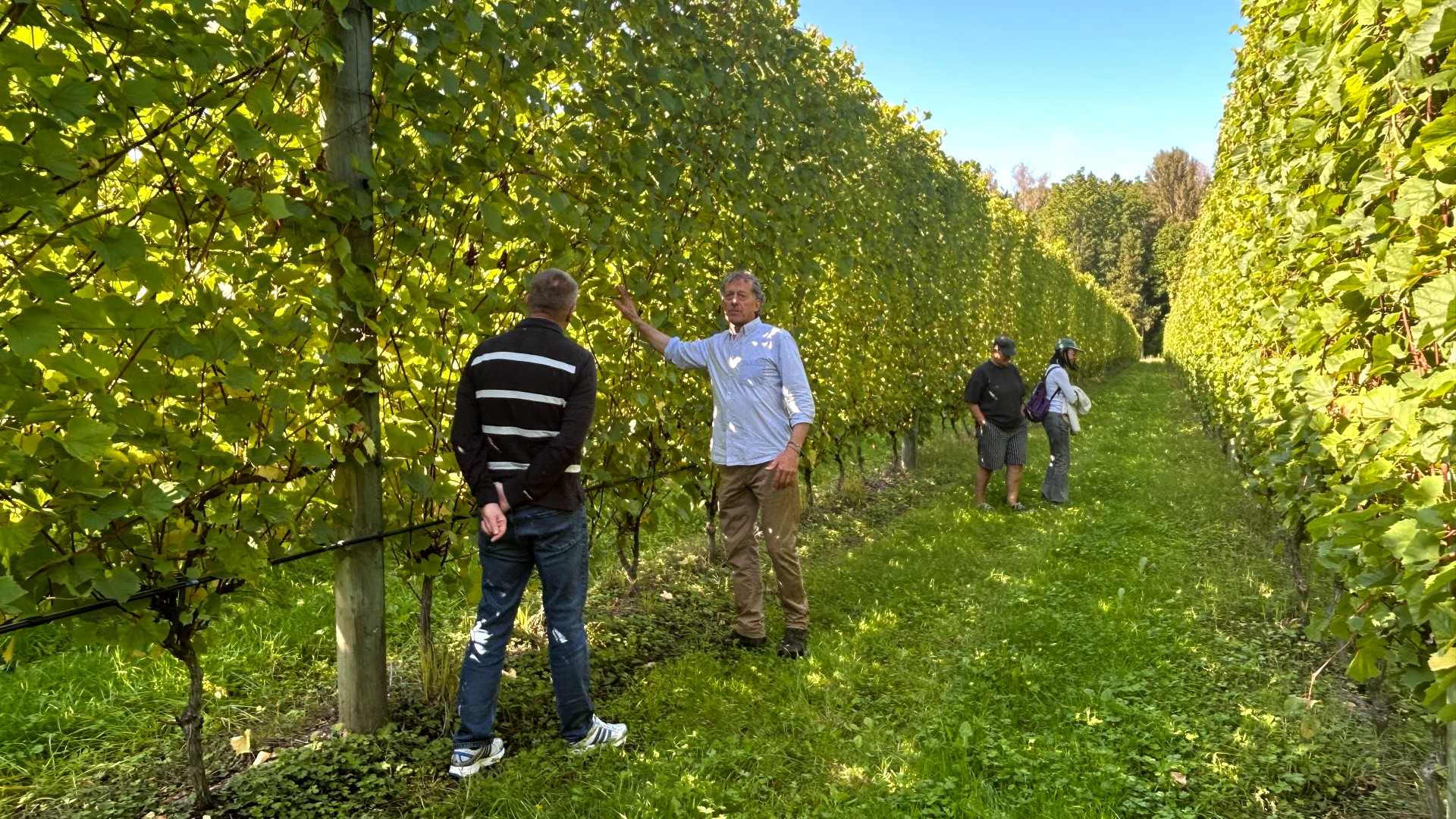
Geoff Thorpe, Riversun Nursery - trellised rootstock source block
I was privileged to visit Riversun Nursery located in Gisborne, along with five Europeans and one Kiwi, for an intimate ‘behind the scenes’ tour of their operation as New Zealand’s largest grapevine nursery. Managing Director Geoff Thorpe was our tour guide, and he did not fail to impress. Geoff’s willingness to share insights of his operations and his journey in the propagation sector was second to none. However, little did I know this was going to be a “what makes a great leader” moment. Geoff’s foresight, passion, curiosity, thirst for knowledge, care, ability to stay on the pulse and desire to be the best, helped him adapt, survive and thrive. His story is a shining example of how one strong-willed individual dreamt big, put the effort in to effect change - advocating for and leading best-practice in producing ‘high health’ grafted grapevines above all. And he was ultimately willing to handover his “play sheet” to his competitors for the betterment of the viticulture industry….all so he could sleep at night. Hat’s off Geoff. A reputation build on quality certainly stands the test of time. Now we have serious work to do in Australia…
Opening my eyes to the virus diseases grapegrowers are combating outside Australia
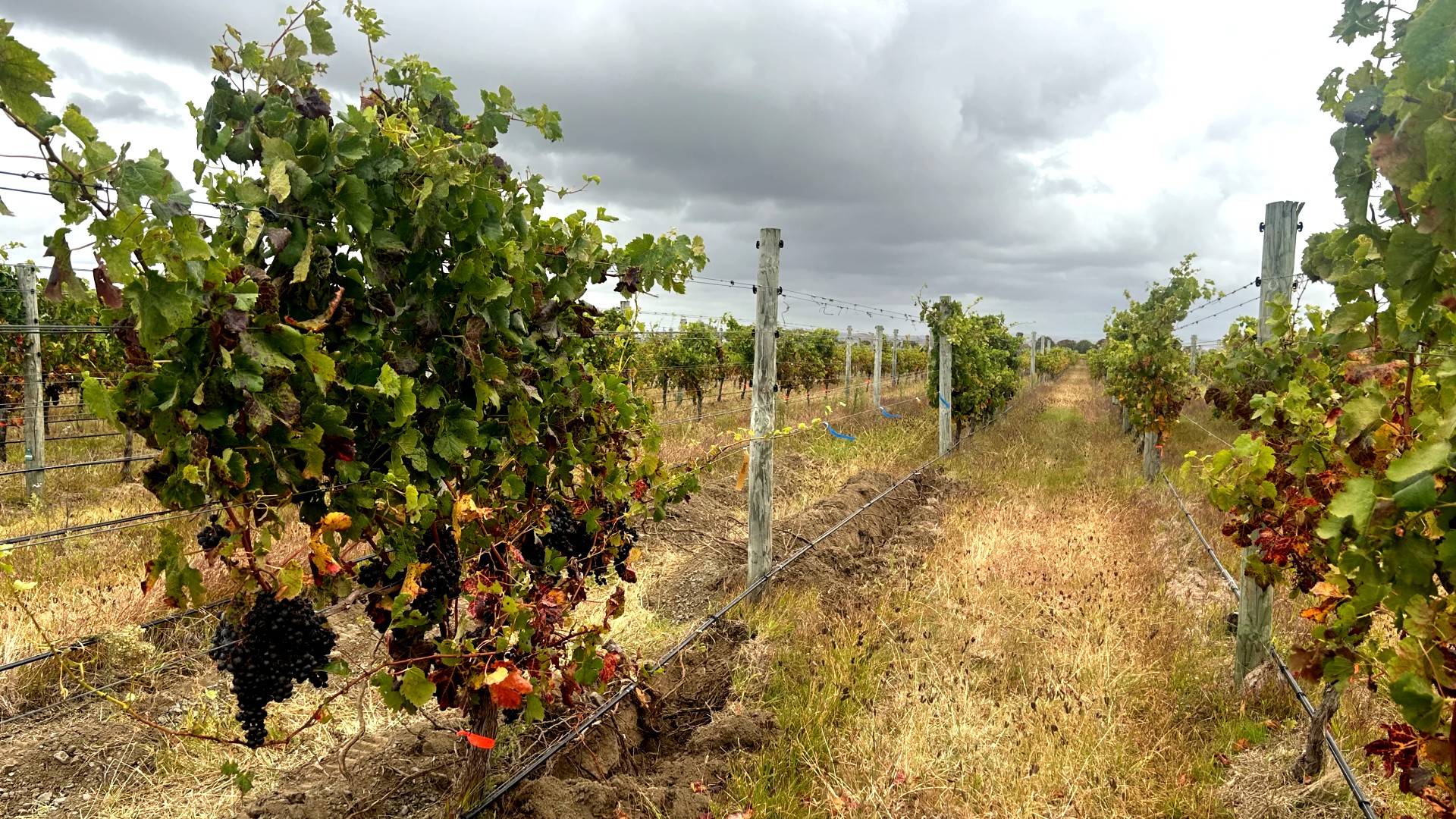
Grapevine leafroll virus 3 infected vineyard
My final part of the trip was attending the 21st International Council for the Study of Virus and Virus-Like Diseases of the Grapevine (ICVG) conference in Napier, which was a combination of presentations, round table discussions, a field trip to the Gimblett Gravels area of Hawke’s Bay, a chance to taste some fine wines and gin, and to meet some renowned virologists and extension practitioners.
Harvesters are mealybug spreaders – vineyard owners take note
Using ‘Smart Water’ UV fluorescent ink, a researcher from Cornell University has basically ‘tagged’ mealybugs and placed them in a vineyard and measured their spread from their original position to show that harvesters can disperse mealybugs up to two rows over from their original position (around 3.5 to 5m) compared to natural movement (measured at 30cm per year in the prevailing wind compared to just 2.5cm in the opposite direction along a row). Basically, this means that machine harvesters can not only spread mealybugs (and presumably scale) within an infected block to speed up the rate of virus spread in your vineyard but can also to move these vectors into ‘clean’ blocks if you haven’t (adequately) washed down your harvester first.
Remnant vine roots can play a significant role in virus transmission
Sound a bit familiar? The transmission of phylloxera from remnant grapevine roots was first identified by growers in Europe in the late 1800s, who noticed that even after infected vines were uprooted, new plantings would often become reinfested. Scientists determined that phylloxera could survive on leftover root fragments in the soil, which acted as a reservoir for reinfestation. Again, the problem with not being able to effectively remove root material from infected vines is a key reason why New Zealand grapegrowers are struggling to limit the spread of grapevine leafroll virus 3 which is being vectored by the citrophilus mealybug that lives on the vine roots. The virus has been detected in remnant roots 12 months after rogueing, with newly planted vines showing visual virus symptoms within two years. Fortunately, this species of mealybug has not made a grand appearance in our Australian grapegrowing regions to date.
Reconsider your rogueing tactics
With initial advice on rogueing not working, the recommendation for which vines to rogue to limit spread of leafroll virus in New Zealand vineyards has changed. Removing one vine on all sides of an infected vine is the current suggested practice - yes this means down and across rows, and will likely mean you are removing vines which aren’t yet showing symptoms of infection. This strategy is more in line with that also being employed by our US counterparts. This ought to be the recommended practice in Australia too; especially where a block has known mealybug or scale issues.
Are you willing to pay?
We know that ‘clean’ vines are the cornerstone of establishing long term sustainable vineyards and therefore that grapevine certification systems are very important. But Australian grape growers − how badly do you really want vines that are free from economically-damaging viruses and how much would you pay? Successful grapevine certification systems overseas have a common denominator in being driven by growers. Again, growers must be the drivers to ask for certified material. Our industry is taking its time to develop a single certification system, but are we showing as an industry that we collectively care? Could our state governments and even some of our grape levies contribute to subsiding the checks and balances which are needed to build trust in such a system?
Wrapping up: What can we do in SA?
- Tell your own brand story well and with heart. Stories, education and imagery can sell wine. Make each of your customers’ experiences with you memorable. Make it personal and about your journey (what’s important to you), why you do what you do and how you do it. Think about what tourism offerings can be best tell your story and how they fit with your strengths – if online then focus on your storytelling on your website and consider adding in video focussed on people and/or use emotive imagery – if in person, how can you create an offering to stand out from the crowd and create buy-in to your philosophy? Do you have knowledgeable, people-focussed staff who can deliver your message in line with your values?
- Build your marketing strategy around your uniqueness: whether it’s your history/landscape/location/viticulture/winemaking, make that front and centre. E.g. use your old vines if you have them, as this is one of SA’s unique selling points (thanks to strong biosecurity practices for keeping phylloxera out and relatively few replants due to virus). I did not hear this talked about once in NZ.
- Charge for tastings: consider the opportunity such a format can create for you to build rapport with your visitors while you convey your personal story. Time is short these days and it’s the personal attention, interactions and knowledge sharing which we crave and will remember.
- Coordinate tasting times: if your cellar door offers scheduled tastings and you have other cellar doors nearby, consider sharing these times to ensure you can each offset your tasting times to maximise visitations for all.
- Use lightweight glass: encourage your glass manufacturers to continue investment in this space. While Margaret River has championed lightweight glass of late, let’s start the movement on a broader scale in SA.
- Take a stance: If we are truly serious about the long-term sustainability of our wine industry, we won’t stand around waiting for the Australian propagation sector (vine improvements and nurseries) to collectively improve their Production Standards for our benefit − rather we will demand higher quality planting material from them, and be prepared to pay for it; acknowledging that a strong certification system requires considerable time and resources to implement, maintain and continuously improve.
- Clean your harvesters: engage your contractors and your staff to ensure harvesters are thoroughly cleaned after picking a block known to contain mealybug or scale, before moving into a ‘clean’ block.
- Remove more vines when rogueing: if you are rogueing individual virus-infected vines in your block, you will reduce the rate of spread of the virus across your block more effectively by removing one vine on all sides of each visually affected vine, compared to removing visually affected vines alone.
- Get behind the GWC program: if ongoing learning is a key principle to the future success of our wine businesses (tick), we must actively advocate for the Great Wine Capitals network. I implore every business that’s had an employee participate in the program, to activate their “Great Wine Capitals Adelaide sales pitch” and find opportunities when talking to visitors, customers and other staff to discuss the value derived from in-country learning and its impact on our businesses and state to improve future business and industry sustainability.
Thank you Adelaide for the opportunity and to the broader Great Wine Capitals network for having me!
Suzanne was supported by the Great Wine Capitals Outbound Knowledge Exchange bursary program, and Wine Grape Council of South Australia.
Photos by Suzanne McLoughlin